 AWS
 Azure
 Google Cloud
In one sentence: a CDN bills a flood by request count, not by bytes, so a rate limit at the edge and a cache key that ignores junk query strings matter more to the bill than any bandwidth setting.
Symptom
The request line of the CDN bill climbs steeply while data transfer barely moves. Request counts are up by an order of magnitude, bytes per request are tiny, and the cache hit ratio drops because each request carries a different query string, such as ?r=8f3a.
How it happens
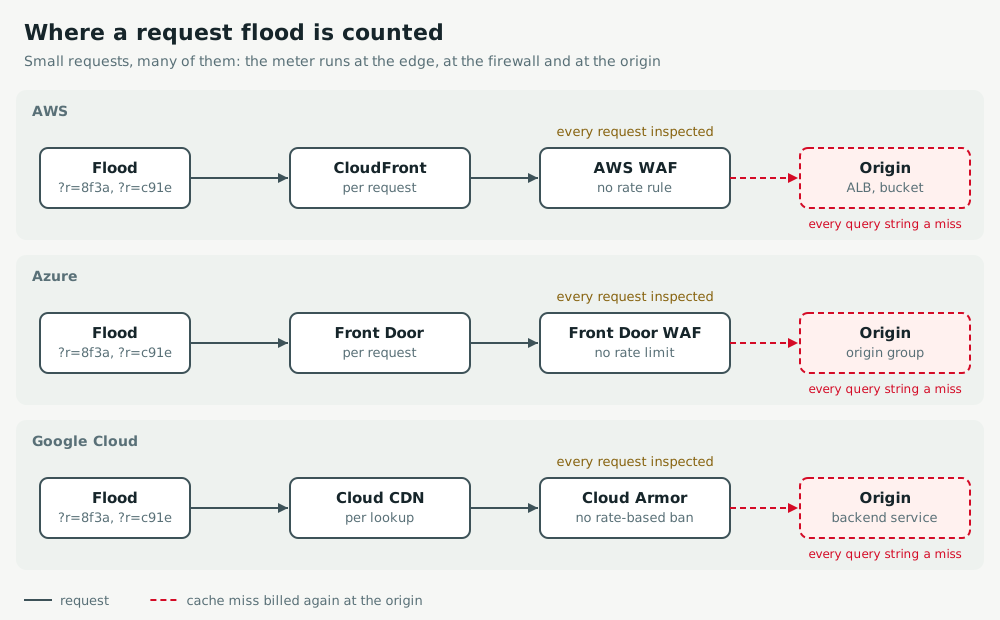
- Every request is metered: the edge counts it whether it is a hit or a miss, and the firewall in front of it counts every request it inspects.
- Random query strings defeat the cache: when the cache key includes every query string, each request is a miss, so the flood also reaches the origin and is billed there a second time.
- The fix is at the edge: a rate limit per client turns the flood into cheap rejections, and a narrow cache key turns what remains into hits.
Act
AWS
Attach a web ACL of scope CLOUDFRONT (managed from us-east-1) with a rate-based rule keyed on IP, placed before the managed rule groups. On each cache behaviour, use a cache policy whose query string list holds only the parameters the content varies by.
{"Name": "per-ip-limit", "Priority": 0, "Action": {"Block": {}},
 "Statement": {"RateBasedStatement": {"Limit": 2000, "EvaluationWindowSec": 300,
   "AggregateKeyType": "IP"}},
 "VisibilityConfig": {"SampledRequestsEnabled": true,
   "CloudWatchMetricsEnabled": true, "MetricName": "per-ip-limit"}}
Azure
Add a rate limit custom rule to the Front Door WAF policy, in prevention mode. A rate limit rule needs a match condition: match the paths the flood targets. On each route, set query string caching to "Use specified query strings" and list only the ones that matter.
az network front-door waf-policy rule create -g rg-web --policy-name wafedge -n perclient \
  --rule-type RateLimitRule --rate-limit-threshold 1000 --rate-limit-duration 1 \
  --action Block --priority 10 --defer
az network front-door waf-policy rule match-condition add -g rg-web --policy-name wafedge \
  -n perclient --match-variable RequestUri --operator Contains --values /api/
Google Cloud
Cloud Armor rate limiting lives in a backend security policy, which sees cache misses: the requests that reach the origin. Add a rate-based ban, then restrict the cache key to the query parameters that change the content.
gcloud compute security-policies rules create 1000 --security-policy=storefront-policy \
  --src-ip-ranges="*" --action=rate-based-ban --enforce-on-key=IP \
  --rate-limit-threshold-count=600 --rate-limit-threshold-interval-sec=60 \
  --ban-duration-sec=300 --conform-action=allow --exceed-action=deny-429
gcloud compute backend-services update storefront --global --cache-key-query-string-whitelist=v
Keep watch
AWS
Alarm on the distribution's Requests metric against its usual peak, and on the web ACL's BlockedRequests for per-ip-limit. In Cost Explorer grouped by usage type, the Requests-Tier lines should flatten once the rule blocks.
Azure
Alert on the profile's Request Count and on Web Application Firewall Request Count split by action. During a flood, blocks rise while Origin Request Count stays flat.
Google Cloud
Alert on loadbalancing.googleapis.com/https/request_count grouped by cache_result. In the load balancer logs, jsonPayload.enforcedSecurityPolicy.outcome="DENY" counts what Cloud Armor rejected.
Exercise
Hold the line yourself: Storefront slows under a traffic surge, then Defences look active but let everything through.